How Does Cashback Work? The Plain-English Guide (With My Real Transactions)
The Cashback Chap
Member since November 2023 · 123 purchases tracked
Last verified 8 September 2026
Last verified: 8 September 2026 · By The Cashback Chap
Cashback means exactly what it says: you buy something, and some of the money comes back to you. What confuses people is why anyone would give you money for shopping, and why it then takes six weeks to arrive. Both have simple answers. Here's how cashback works — the three different kinds, where the money actually comes from, and what it looks like in a real account (mine: 123 transactions, £1,636 back).
Disclosure: cashback links here are my referral links — free for you, they fund the testing.
The 30-second version
- A retailer pays a commission to whoever sends it a customer — the same budget it spends on adverts.
- A cashback site sends you to the retailer, collects that commission, and passes most of it to you.
- You shop exactly as normal, at the normal price. Weeks later, the retailer confirms the sale and the money becomes yours to withdraw.
That's it. It isn't a discount, a voucher or a loyalty point. It's a slice of the retailer's marketing spend, redirected to the customer.
Where the money comes from (and why it's not "too good to be true")
When you click from a cashback site to, say, a jeweller, a tracking link tells the jeweller "this customer came from us". If you buy, the jeweller pays the cashback site a percentage — its affiliate commission. The site keeps a cut and credits you the rest. Nobody's giving money away: the retailer would have spent that money acquiring a customer anyway; the cashback site simply competes for it by handing you the bulk.
That's also why prices are identical whether you click through or not, and why cashback is only ever "free money" on purchases you'd make regardless. Buy something because of cashback and you've spent 87% to save 13%.
The three kinds of cashback
1. Cashback sites (click-through)
TopCashback, Quidco, Rakuten. You start on their site or app, click through to the retailer, buy. Rates run 1–15% on shopping, with flat bounties (£20–£120) on switches like insurance, energy or a mobile contract, and occasional 100%+ offers to win new subscribers. Highest earning potential; slowest to pay. This is where nearly all my £1,636 came from — my TopCashback walkthrough shows it step by step.
2. Instant cashback apps (gift-card model)
JamDoughnut, Cheddar, EverUp. You buy a gift card for the shop inside the app; cashback (typically 3–10%, up to ~20% on promotions) lands instantly; you spend the gift card in store or online. Faster and simpler, but you commit the money up front and only listed brands count.
3. Cashback credit and debit cards
The card issuer returns a small percentage of everything you spend — usually 0.5–1%, sometimes more for an intro period — as a statement credit or "rewards" balance. Automatic and instant-ish, but small, and pointless if you carry a balance (interest dwarfs it). Card-linked apps like Airtime Rewards sit in between: link a card, earn at partner retailers automatically, redeem as phone-bill credit.
The kinds stack: click through a cashback site, pay with a cashback card, and you earn twice on the same purchase.
What actually happens to a transaction
Here's a real one — a Gousto meal box I ordered on 28 August, £18.50:
| Stage | What it means | My Gousto box |
|---|---|---|
| Tracked / Pending | The click registered and the retailer reported a sale; amount shown but not yet yours | £20.00 pending, same day |
| Confirmed | Retailer has verified the sale (returns window / cooling-off passed) | Confirmed in 4 days |
| Payable | Money is released to you; withdraw to bank, PayPal or a gift card | Withdrawn with my next payout |
| Declined | Retailer rejected the sale — didn't qualify, or a duplicate tracking entry cancelled | — |
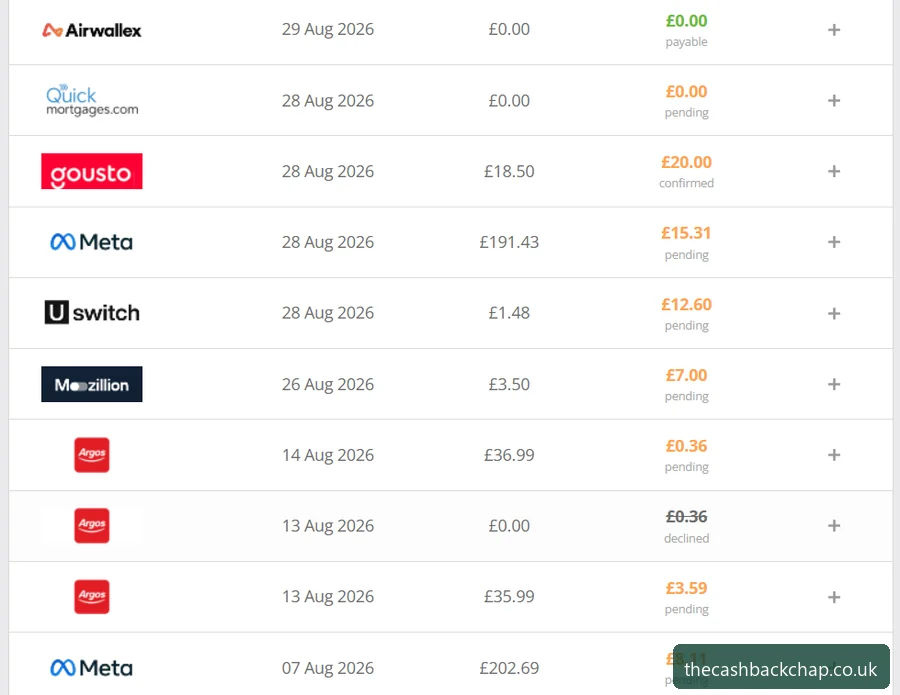
Gousto was unusually quick. Across my account the wait from purchase to payout has ranged from 4 days to 26 weeks — retailers confirm after their returns window, insurers after cooling-off, travel after you travel. Realistic expectations are in my payout-times guide.
Why cashback is "not guaranteed" — and what breaks it
The tracking relies on the retailer recognising your visit came from the cashback site. Things that break that link:
- Using an unofficial discount code — the code's owner gets the commission instead of you. My biggest single loss (£67.83 on a VPN) was exactly this.
- Leaving and coming back via Google, an email, or a price-comparison tab.
- Ad-blockers or blocked cookies stopping the tracking cookie.
- Not qualifying — "new customer" offers on an existing email/address.
- Paying with gift cards where the listing excludes them.
Follow the rules and tracking is remarkably reliable: in 123 purchases, mine has never missed a genuine one. About £98 has been declined for reasons that were mine, and roughly as much again was duplicate entries that cost nothing — both decoded in what to do when cashback is missing.
How much can cashback actually be worth?
The everyday-shopping answer is modest — 1–5% of what you'd spend anyway. The answers that made my account interesting were the other mechanisms:
- Bounties: £120 for switching mobile network, £45 on car insurance.
- 100% offers: antivirus and a VPN that cost nothing after cashback.
- High-rate categories: jewellery paid me 13% (£124.58 on £958.33); hotels 11%.
- Referrals: £25 per friend who joins — my biggest stream.
Blended across three years: about £48 a month for a minute of effort per purchase. Whether that's worth it for you is the honest question here.
FAQ — real questions people ask Google
How does cash back work for dummies? You start at a cashback website, click its link to the shop, and buy as normal. The shop pays the cashback site a commission for sending you; the site gives most of it to you a few weeks later, once the shop confirms the sale. Prices are the same either way.
Is cash back like free money? On purchases you'd make anyway, effectively yes — it's the retailer's marketing budget redirected to you. It stops being free the moment cashback persuades you to buy something you wouldn't otherwise have bought.
Do you actually get money from cashback? Yes, real money: I've withdrawn £1,547.12 from TopCashback to my bank over three years, in payouts from a few pounds to £216.20. It arrives weeks to months after the purchase, not instantly.
Is there a downside to cashback? Three: it's slow, it isn't guaranteed if you break the tracking rules (I've lost about £98 that way), and it can nudge you into extra spending. Managed sensibly, none of them outweigh the return.
Transaction figures are from my own TopCashback account (screenshot shown), verified 8 September 2026. Sources: MoneySuperMarket — cashback cards · Chase UK — cashback explained · r/UKPersonalFinance.
New to TopCashback? You get £10 too.
Join through my link and TopCashback adds a £10 bonus once you've earned £10 in cashback — on shopping you'd do anyway. Free to join; new-member terms apply, and it's how this site keeps testing.